segunda-feira, 7 de novembro de 2011

Verbs, verbs, verbs...

Verbs have traditionally been defined as words that show action or state of being.


Verbs can also sometimes be recognized by their position in a sentence.
In the following two sentence frames, only a verb can be put into the empty slot.

            NOUN __________                            THERE ________ NOUN
                            (verb)                                                        (verb) 
         
Often, prefixes and suffixes (affixes)  will signify that a word is a verb.  For example, the suffixes -ify, -ize, -ate, or -en usually signify that a word is a verb, as in typify, characterize, irrigate, and sweeten.  Prefixes such as be-, de-, or en-  may signify that a word is a verb, as in bestow, dethrone, and encourage.  
These affixes, often inconsistent from verb to verb, are called derivational affixes. Added to a word, they either change the word's part of speech

Example:


or change the word's meaning

Example:


The base form of a verb is derived from the verb’s infinitive:  to  +  verb


Four suffixes consistently added to a verb’s base create all forms of a verb used in all tenses:
 
1. -s          creates 3rd person singular / present tense  (He talks.)
2. -ing       creates the present participle / used with be  (He is talking.)
3. -ed        creates the simple past  (He talked.)
4. -en        creates the past participle / used with have  (He has talked.)
 
Note:
The -en verb ending used with a form of to have as an auxiliary is generally written -ed, as in has talked.
      
Unlike the derivational affixes, these inflectional suffixes are consistently used with all verbs, even though their form may look different from verb to verb.

Because many verbs in English are irregular; as result, their ed and/or –en  endings may not follow any obvious pattern.

Examples:
(to write)
Smith writes short stories at home. (-s ending)
Smith is writing short stories at home. (-ing ending)
Smith wrote short stories at home. (-ed ending)
Smith has written short stories at home. (-en ending)
*
(to buy)
Jones buys a newspaper each day.  (-s ending)
Jones is buying a newspaper today.  (-ing ending)
Jones bought a newspaper yesterday. (-ed ending)
Jones has bought newspapers every day.  (-en ending)
*
(to go)
Students go to the library often. (-s ending)
Students are going to the library often. (-ing ending)
Students went to the library often. (-ed ending)
Students have gone to the library often. (-en ending)
    
      
The majority of verbs are regular and consistently use -ed and -en to form their simple past tense and past participles. (e.g. talked, has talked)
    
Many verbs are irregular, however, and follow no consistent pattern in creating their -ed and/or -en forms.  A list of the major irregular verbs is shown below.

Present
Past (-ed form)
Past Participle (-en form)
arise
arose
arisen
ask
asked 
asked
attack
attacked
attacked
awaken
awakened OR awoke
awakened
bear
bore
borne/born
begin
began
begun
blow
blew
blown
break
broke
broken
bring
brought
brought
burst
burst
burst
choose
chose
chosen
cling
clung
clung
come
came
come
dive
dived OR dove
dived
do
did
done
drag
dragged
dragged
draw
drew
drawn
drink
drank
drunk
drive
drove
driven
drown
drowned
drowned
eat 
ate
eaten
fall
fell
fallen
fly
flew
flown
forgive
forgave
forgiven
freeze
froze
frozen
get
got
got OR gotten
give
gave
given
go 
went
gone
grow
grew
grown
hang (things)
hung
hung
hang (people)
hanged
hanged
happen
happened
happened
know
knew
known
lay
laid
laid
lead
led
led
lie
lay
lain
loosen
loosened
loosened
lose
lost
lost
pay
paid
paid
ride
rode
ridden
ring
rang
rung
rise
rose
risen
run
ran
run
see
saw
seen
set
set
set
shake
shook
shaken
shrink
shrank OR shrunk
shrunk OR shrunken
sing
sang
sung
sink
sank OR sunk
sunk
sit
sat
sat
speak
spoke
spoken
spin
spun
spun
spit
spat
spat
spring
sprang OR sprung
sprung
steal
stole
stolen
sting
stung
stung
stink
stank OR stunk
stunk
strive
strove
striven 
study
studied
studied
swear
swore
sworn
swim
swam
swum
swing
swung
swung
take
took
taken
tear
tore
torn
throw
threw
thrown
wake
woke OR waked
woken OR waked
wear
wore
worn
weave
wove
woven
wring
wrung
wrung
write
wrote
written
    
A verb phrase is defined as the main verb together with all its auxiliaries (helping verbs).
Auxiliary verbs always precede the main verb.

There are two types of auxiliary verbs:

1. Inflected auxiliary verbs:  

be
have do

2. Modal auxiliaries (considered more fully under (auxiliary verbs)

present
past no tense
will
would
must
shall
should
 
can
could
 
may   might  
    
Examples of verb phrases:

He has taken the test.
(auxiliary has  +  main verb  take.)
He is taking the test.
(auxiliary is  +  main verb  take)
He did take the test.
(auxiliary do  +  main verb take)
He has been taking the test.
(auxiliaries has been + main verb take)

Verbs may be divided into three types:

A.     Action verbs - show an action -- either physical or mental


B.   Verbs of being (forms of be - is, are, was, were, has/have/had been, will be) - show a state of existence:  


C.  **Linking verbs - link a subject with its complement 
            (A subjective complement "completes" / "equals" the subject.)
            Linking verbs:  appear, taste, smell, feel, look, sound, grow, seem, remain, become


        NOTE:  Most linking verbs can also be used as action verbs.


Action verbs may be either transitive or intransitive.
A.  A transitive verb is one that is followed by a direct object.

Example: 


B.  An intransitive verb is one that is NOT followed by a direct object.

Example:

          
Caution:  An intransitive verb may be followed by adjectives, adverbs, and/or prepositional phrases.  As long as the verb is not followed by a noun or pronoun functioning as the direct object, the verb is intransitive.

Example: 


NOTE:  Some action verbs may be either transitive or intransitive.
  Example:  (left


          Another example (read):                   


Verbs have three moods:  indicative, imperative, and subjunctive.

A. The indicative mood states a fact, asks a question, or exclaims.


B. The imperative mood gives a command.  The subject is always "you" understood. 


C. The subjunctive mood occurs in two instances:

1. The sentence indicates a situation contrary to fact.


2. The sentence

  • shows a wish, desire, or demand 
  • following verbs such as desire, demand, request, suggest


 From: Towson University - Towson University's Online Writing Support

domingo, 6 de novembro de 2011

English Verb System


Hello, everyone!

Quando se estuda gramática, tem que se ter presente o fato de que não é apenas a forma (form) que se deve considerar como objeto de estudo. É preciso sempre lembrar que essa forma deve ter significado (meaning). Além da forma e significado, é preciso considerar também o uso (use).
Vamos recordar o sistema verbal da língua inglesa e como ele se comporta na formação das sentenças, tendo sempre a idéia acima em mente.

Linking Verbs
 
Por linking verbs entende-se os verbos que, basicamente, fazem a ligação entre o sujeito da sentença e o que se diz do sujeito.
Os verbos mais comuns são: be, seem, look, feel, appear, become, grow, sound, taste, go, get, smell, prove.
 
Exemplos:
 
I am proud of my students. achievements.
All the participants seemed happy.
The class activity proved to be interesting.
It is becoming darker and darker. Let.s take a cab!
His idea sounds good, doesn't it?
This pasta tastes awful. What's wrong with it?
After the crash of the Concorde, everybody wants to know what went wrong and what the future of supersonic travel is.
Some people say this world is going crazy.
My ancestors were farmers.
I am getting hungry. How about going to the school cafeteria?
Contrary to parents' expectations, the two brothers became Catholic priests.
Betty seems (to be) the ideal person to look after (take care of) the children.

A new supermarket has been built round the corner. (Passive Voice)
A: What does your brother do for a living?
B: Don't you know? He is a physician (doctor of medicine).
 
Auxiliary verbs
 
Vão ajudar dar sentido ao verbo principal. São eles:
a. am, is, are, was, were
b. have, has
c. do, does, did
d. will 

Exemplos:
 
A: It.s 1 p.m. I am starving. (Present Progressive or Continuous)
B: No kidding!

I don't believe it's raining again! It will spoil my Sunday! (Simple Future)
I have already finished reading the book for my Literature class. (Present Perfect)
Has your sister returned from work yet? (Present Perfect)
Nothing will prevent me from succeeding! I am determined to succeed.
Do you ever go to church on Sundays? (Simple Present)
Does your brother speak Spanish? (Simple Present)
Did you visit the Tower of London when you were there? (Simple Past)
 
Modal Verbs
 
São verbos que dão ao verbo principal, sempre na forma infinitiva, um determinado sentido ou sinalizam uma determinada função (proibição, não necessidade, habilidade, etc...) e, assim, não são usados de forma isolada; funcionam como auxiliares e nunca mudam a forma.
São os seguintes: can / could, may / might, ought to (= should), must, have (has) to / had to,
need, além das expressões had ('d) better e would ('d ) rather.

Can/could
 
Can e could (além de would) podem ser usados para solicitar alguma coisa ou pedir a alguém para fazer alguma coisa.

Exemplos:
 
Can I use your cell phone?
Could you close the door?
Would you mind opening the window?

Can e could (além de may -. forma mais polida) podem ser usados para fazer um pedido ou pedir permissão para fazer alguma coisa.

Exemplos:
 
Can I leave five minutes earlier?
Could I help with the box?
May I come in?
 
Quando a permissão é dada ou recusada (no tempo presente), podemos usar tanto can quanto may.


Exemplos:
 
You can't use this computer now; it is out of order and will be repaired tomorrow.
You may not sit here. Choose another seat.
The students can.t take more than three books from the library at a time.
You can use any of these dictionaries.
Students can (= are allowed to) wear jeans in my school.
You can't (= are not allowed to) park here. The sign says "No Parking".
 
No tempo passado, could (= was, were allowed to) deve ser usado para falar sobre permissão ou para reportar idéias.

Exemplos:
 
I couldn.t use the phone for personal calls when I worked there.
Pete said that his brother could use his car.

Can (present) e could (past) são usados para falar de habilidades que uma pessoa tem (não tem) ou tinha (não tinha).

Exemplos:
 
When my mother was young, she could dance beautifully.
Ronald can play soccer very well.
I can't talk to Mr. Nakamura as I don.t speak Japanese.
Sorry, I can.t understand you.
I couldn't swim when I was a child.
 
Uma outra maneira de expressar habilidade é usar know how to.
 
Exemplo:
 
I don.t know how to play the piano.
My sister knows to deal with this equipment.
 
Must (has to, have to)
 
Indicam que há necessidade de se fazer alguma coisa.

Exemplos:
 
You're my son. You must tell me the whole truth.
Sorry, I can't go with you. I have to go to the dentist right now.
You must fill out the form in ink. Also, you have to sign your name in full.
 
Must também é usado para indicar um fato aparentemente óbvio ou uma dedução da qual temos certeza:

Exemplo:
 
There are no lights on in the house. Evelyn must be out.
You must be tired. You worked hard all day long.

A: Chris told me she lived in the U.S. for three years.
B: Her English must be good.
 
Mustn't indica proibição:

Exemplo:
 
Students mustn't enter the classroom after 7 o.clock.
 
Should / Ought to
 
Should é usado para dizer que é aconselhável (ou não) fazer alguma coisa.

Exemplos:
 
X-Men'. is a great movie. You should see it.
I shouldn't live under so much pressure. I know it is not good for my health.
Cars in Brazil cost a lot of money. They ought to cost less.
You shouldn't leave your baggage unattended. Keep an eye on it.
 
Had better tem sentido mais enfático que should, sugerindo que, se algo não for feito, poderá haver alguma consequência.

Exemplos:
 
A: I don.t feel OK today.
B: You'd better go home.

This is my first school day. I.d better not be late.
 
May / might

Expressam probabilidade.

Exemplo:
 
A paragraph may be as short as a single word or as long as many pages.
You might be surprised when you hear the news today.
 
Would rather
 
É uma expressão que dá o sentido de preferência.

Exemplos:
 
A: What did Monica tell you yesterday?
B: I.d rather not say.

It's getting too smoky here. I'd rather leave the room. Let.s talk some place else.
 
Should have + past participle alguém lamenta não ter feito alguma coisa ou feito alguma coisa errada

Exemplo:
 
The Beach' is not on any more. You should have seen it.
I shouldn't have said that. It was very rude of me.
 
Must have + past participle dedução lógica de que algo aconteceu no passado.

Exemplo:
 
Your grade is 10. You must have studied a lot for this test.
 
Could have + past participle alguma coisa foi possível, mas não aconteceu.

Exemplos:
 
When I was in Lisbon, I could have stayed at the Hilton, but I decided to save some money and chose a cheaper hotel.

Davidson could have been selected for this position if he had been applied for as he is highly qualified.

This is it!
See you, 
Teacher Jô 

From: Sobre Vestibular 
 

sábado, 5 de novembro de 2011

Mary and Max: Pen Pals With Problems

Director Adam Elliot chats with Tom Sito about the making of his first clay-animated feature, Mary and Max, which premiered last night at Sundance.


Australian clay animation director, Adam Elliot, who has had a series of successful shorts capped by his Oscar-winner, Harvie Krumpet, has just completed his his first feature, Mary and Max. It is about the long-distance relationship of a lonely Australian girl and an obese, autistic middle-aged, New York City shut-in. Mary and Max opened the 25th Anniversary Sundance Film Festival last night, the first animated film ever to be so honored. Recently, animator and director Tom Sito had a chance to talk to Elliot.
Tom Sito: What was the inspiration for such a unique story? I read that Max is based upon a real-life friend?
Adam Elliot: Yes, Max is a pen-friend in New York I've been exchanging letters with for 20 years. After Harvie Krumpet, I thought, "What do I do now?" I wrote about my cousin, my brother, my uncle. Then, I noticed a big box on the floor piled up with all of my friend's correspondence. I began going through them. I had forgotten how interesting he and his story were. Five years later, we have a movie.
TS: Your characters have had asthma, cerebral palsy, Asperger's syndrome, autism -- what the [BLEEP] is wrong with you?
AE: [Laughs] I get asked that question a lot. Maybe one day I'll write something more mainstream about fish or something. In Australia, I'm seen as the Patron Saint of Disabled Film. The way I see it is everyone has some kind of flaw; it's just how you perceive your flaw. My friend with autism doesn't see it as a flaw. To him, being autistic is as much a part of who he is as the color of his eyes. I guess I like to defend the people society tends to marginalize, the people who are different. I gravitate towards their interesting stories.


TS: You have famous actors like Philip Seymour Hoffman, Toni Collette and Eric Bana doing tracks for you. How is it to work with stars who may not have done animation before?
AE: I try to look for actors who have not done animation yet. That's getting kinda hard. When I thought of Max, I thought of some big, urban, New Yorker type. I had just seen the film Capote with Philip Seymour Hoffman in it. The more I thought of him, he just ticked all the boxes. Toni Collette and Eric Bana were a plus being that they are Australians. They could just drive over themselves, with no entourage, and do their tracks. For all of them it wasn't the money, they really dug the script. They found it wasn't the usual animated fodder.
TS: Could you work in person or did they do it long distance? Could you record them together or all recorded separately?
AE: We recorded them all separately. Like I said, Toni, Eric and Barry [Humphries] were in the neighborhood. To do Philip, we recorded him in a sound studio hook-up first in New York and then in London. At first I was thinking, "Aw God, this will never work. It's not the same like being there in person directing them." But the sound hook-up quality was so clear, and we had a visual Skype going so we could see each other. So it was just like being in the other room.
TS: You come from making short clay animation films. How is the move to feature films different?
AE: It was like starting all over again. Learning to collaborate with a large crew. Nick Park said it was having to be creative with a gun to your head. I say it's like making love and being stabbed to death at the same time! [Laughs]. Originally, I sorta missed being alone, working with the clay, but it was good working with a bigger team, each bringing his or her own special craftsmanship.
TS: You mentioned that clay animation is a very personal way of making animation. How did you, as a director, make sure everyone's personal way of timing the characters matched?
AE: Absolutely, that was one of my biggest fears. I didn't want Max to have multiple personalities. We had very little prep time, so I had to put together workshops and style bibles. I had a phrase we used over and over: "Chunky-Wonky." No straight lines; keep it off and at odds.

sexta-feira, 4 de novembro de 2011

Mary & Max


O primeiro filme longa metragem do diretor australiano Adam Elliot. Um projeto muito ousado! Todo modelado em argila (cenário, personagens e etc) e usando a técnica de stop motion (cada cena fotografada quadro a quadro). Praticamente todo narrado.


A narração apresenta temas como suicídio, desemprego, obesidade, alcoolismo, cleptomania e entre outros. Obviamente não é indicado para as crianças, mas, a mistura de drama e humor é muito agradável aos adultos.
A história começa em 1976, com o cotidiano da pequena australiana Mary Daisy Dinkle, uma menina de oito anos, ignorada pelos pais e com muitas dúvidas. Por não ter com quem dividir seus sentimentos e dúvidas, escolhe em uma lista telefônica de Nova Iorque um nome aleatoriamente. Nos Estados Unidos Max Horovitz recebe uma carta. E “às vezes, perfeitos estranhos se tornam grandes amigos.”


E interessante destacar a predominância de duas cores: o marrom para o mundo de Mary e o cinza caracterizando o mundo de Max. A demais cores são recorrente em algumas cenas, como o vermelho.


É um filme excêntrico, no entanto encantador em sua técnica, em seu roteiro, no trabalho fotográfico, em tudo. 


Assista o trailer!


quinta-feira, 3 de novembro de 2011

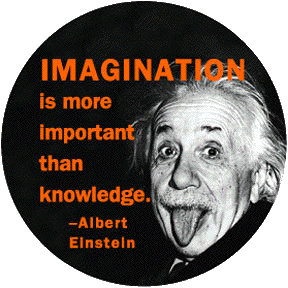
Quotes about Imagination

"Imagination is the eye of the soul."
Joseph Joubert (1754-1824), French philosopher.


"No amount of skillful invention can replace the essential element of imagination."
Edward Hopper (1882-1967), American painter.


"Man consists of body, mind and imagination. His body is faulty, his mind untrustworthy, but his imagination has made him remarkable."
John Masefield (1874-1967), English writer.


"The future belongs to those who believe in the beauty of their dreams."
Eleanor Roosevelt (1884-1962) American diplomat, writer, and First Lady of the United States from 1933-45.


"I used my imagination . . . to make the grass whatever color I wanted it to be."
Whoopi Goldberg, contemporary American comedian.


Source: http://www.artlex.com/

quarta-feira, 2 de novembro de 2011

Subject, Verb, Object

Subject agreement 

A question from Lachlan Brown:
"Hello I have a question about when to use "is" and "are".
I was told by a friend that I sentence I wrote was incorrect because I used "is" when I should have used "are". The sentence I wrote was: "His biggest problem is his inaccuracies." My friend said I should have written: "His biggest problem are his inaccuracies."
My understanding of how to use these words is that "is" is used when talking about a singular noun and "are" is used when the noun is plural. I realise that "inaccuracies" is plural, but I used "is" because "problem" is singular. Can you tell me which noun in my sentence determines when "is" or "are" should be used?"

ANSWER
Susan Fearn:
"Firstly, Lachlan asks whether the sentence 'his biggest problem is his inaccuracies' is right or wrong. He used it and one of his colleagues said it was wrong! The good news, Lachlan, is it's you who is right.
The main actor or subject of the sentence is 'his biggest problem', and this is singular. So the verb in the sentence should agree with the subject. The second actor, the object, is the plural term 'his inaccuracies', but the verb doesn't need to agree with this.
So it's all a question of agreement. In English, the normal word order is subject, verb, object.

My cat (subject) climbs (verb) trees (object)

The verb should agree with the subject, not the object. So cat and climb are agreeing - my cat climbs.

But even first language users of English sometimes have a problem when the sentence has more than one clause - and here's an example:
My sister, but not her friends, is coming to dinner.
We might be tempted to say are coming to dinner. But you don't have to because the verb should agree with my sister. The not her friends section is just additional information.
Source: UOL Educação
Susan Fearn has taught English in Europe, Japan and China and has made programmes for BBC Learning English in the past. She is currently teaching English for Journalism and Public Relations at the University of Westminster in London.

terça-feira, 1 de novembro de 2011

Another Brick In The Wall


Hello, everyone!
Aposto que você já ouviu falar na banda Pink Floyd... Não?! Bom, então está na hora de saber um pouco mais sobre esta que é uma das grandes bandas de todos os tempos e de seu antológico álbum The Wall!
The Wall é o 11° álbum de estudio da banda inglesa de rock progressivo¹ Pink Floyd. Lançado como álbum duplo em 30 de Novembro de 1979 ele foi, posteriormente, tocado ao vivo com efeitos teatrais, além de ter sido adaptado para o cinema.
Seguindo a tendência dos últimos três álbuns de estúdio da banda, The Wall é um album conceitual², tratando de temas como abandono e isolamento pessoal. Foi concebido, inicialmente, durante a turnê In the Flesh, em 1977, quando a frustração do baixista e letrista Roger Waters com seus espectadores tornou-se tão aguda que ele se imaginou construindo um muro entre o palco e o público.
The Wall é uma ópera rock³ centrada em Pink, um personagem fictício baseado em Waters. As experiências de vida de Pink começam com a perda de seu pai durante a Segunda Guerra Mundial, e continuam com a ridicularização e o abuso de seus professores, com sua mãe superprotetora e, finalmente, com o fim de seu casamento. Tudo isso contribui para uma auto-imposta isolação da sociedade, representada por uma parede metafórica.
O álbum contém um estilo mais duro e teatral do que os lançamentos anteriores do Pink Floyd. O tecladista Richard William Wright deixou a banda durante a produção do álbum, continuando no processo como um músico pago, apresentando-se com o grupo na turnê The Wall. Comercialmente bem-sucedido desde o seu lançamento, o álbum foi um dos mais vendidos de 1980, vendendo mais de 11.5 milhões de unidades nos Estados Unidos, atingindo a primeira posição da Billboard A revista Rolling Stone listou The Wall na 87ª posição em sua lista dos 500 melhores álbuns de todos os tempos. 


   “We don’t need no education. We don’t need no thought control”

Another Brick in the Wall e seus versos clássicos ganharão um filme próprio. Os fãs do Pink Floyd  podem festejar com esse longa-metragem que promete ser tão grandioso quanto à música.
No ano de 1982 foi lançado The Wall, filme inspirado na obra do Pink Floyd e dirigido por Alan Parker. Nesta nova empreitada, o cargo ficará por conta de Andy Harries, produtor de A Rainha, que de imediato trato de esclarecer que não se trata de um remake.
A adaptação de Harries, conforme o próprio explicou, será uma mistura de Sociedade dos Poetas Mortos com Escola de Rock e tem foco na história verdadeira das crianças que cantaram na faixa, em 1979, e do professor Alan Renshaw que resolveu fazer uma revolução na escola de Londres tendo como conseqüência o tão emblemático coro estudantil que clamava pela não educação.
O filme com produção da BBC Films e roteiro de Steve Thompson já começou a ser rodado e não tem lançamento previsto, porém ainda aguarda a liberação dos direitos para utilização da faixa que inspirou filme. Já pensou um filme sobre Another Brick in the Wall sem Another Brick in the Wall?
Confira o clipe da música e já entre no clima do filme prometido por Andy Harries


This is it!
See you,
Teacher Jô Piantavinha

¹ Rock Progressivo: O termo foi usado para definir bandas de rock que tinham influência da música clássica e do "avant-garde", usando alguns conceitos desses estilosem sua música. Aliás, o próprio termo "progressivo" em si vem de propostas e formas musicais adotadas por essas vertentes desde aproximadamente os séculos XVIII e XIX.

² Album conceitual: Disco conceitual é quando o CD inteiro explora um tema, ou o cd inteiro é apenas uma música. É o tipo de album no qual todo ele tem começo, meio e fim. É como The Wall do Pink FLoyd, no qual todo o album é uma crítica ao sistema de ensino (e ao sistema em si)... o CD tem todo umas história que pode ser vislumbrada no DVD The Wall.

³ Ópera rock: Ópera rock é uma obra de rock que apresenta uma narrativa contada em diversas partes, canções ou seções, ao estilo de uma ópera. Uma ópera rock difere-se de um álbum convencional por geralmente trazer canções unificadas por um tema ou narrativa em comum, contando uma história com princípio, meio e fim. Uma ópera rock pode ou não ser apresentada de forma teatral. Em formato gravado, pode ser similar a um álbum conceitual, embora este simplesmente mantenha um tema ou estilo específico e as canções não sejam unidas por um enredo. 

Fonte: Rolling Stones; Wikipedia.